
Shared hosting vs VPS hosting is one of the most searched hosting decisions online, and for good reason: picking wrong either wastes money on resources you don’t need yet, or leaves your site struggling on infrastructure it has already outgrown. Both can run the exact same website, WordPress, WooCommerce, or a simple brochure site, but they differ sharply in performance, control, and cost.
This guide breaks down the 7 differences that actually matter, plus the real-world signals that tell you which one fits your site right now.
- Quick Answer: Shared Hosting vs VPS Hosting
- 1. How Resources Are Allocated
- 2. Performance and the "Noisy Neighbor" Problem
- 3. Security and Isolation
- 4. Control and Root Access
- 5. Technical Skill Required
- 6. Scalability
- 7. Price
- Side-by-Side Comparison Table
- 5 Signs You've Outgrown Shared Hosting
- Which Should You Choose?
- How Leanna.ng Supports Both
- Frequently Asked Questions
Quick Answer: Shared Hosting vs VPS Hosting
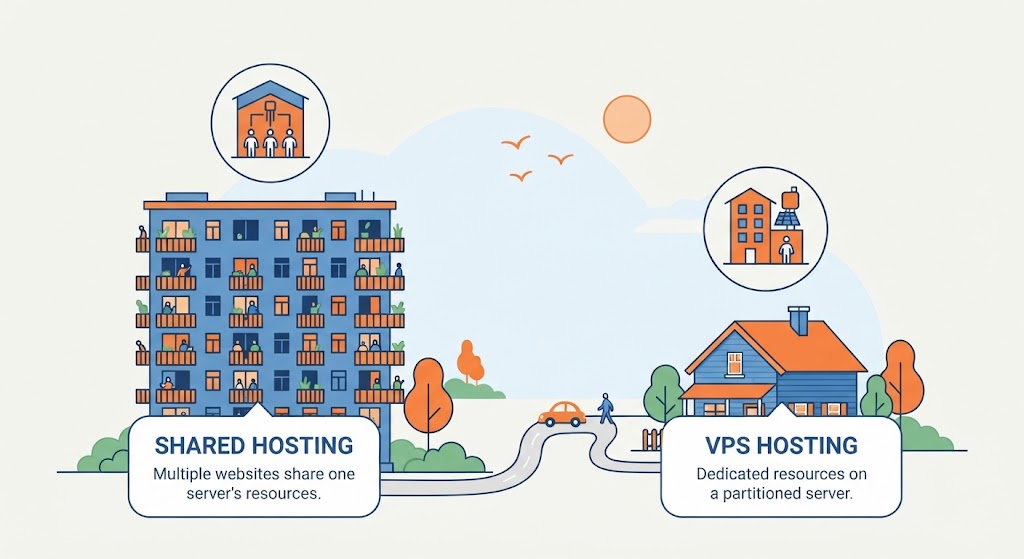
Shared hosting stores your website on a server where it shares CPU, RAM, and storage with many other websites, making it the cheaper, simpler option for beginners. VPS hosting splits one physical server into isolated virtual servers, each with resources reserved for a single customer, giving more consistent performance and control at a higher price. If shared hosting is an apartment building with a shared utility room, a VPS is your own private unit with a dedicated meter and rules you set.
Choose shared hosting if you’re starting out, traffic is modest, and you want the provider to handle everything technical. Choose VPS if your site is growing, traffic arrives in bursts, or you need server-level configuration shared plans can’t offer.
1. How Resources Are Allocated
On shared hosting, your site draws from a shared pool of CPU, RAM, and bandwidth alongside potentially hundreds of other websites on the same physical server. On a VPS, a fixed slice of those resources, a defined vCPU allocation, RAM, and storage profile, is reserved specifically for your site, so no other account can use what belongs to you, no matter how busy they get.
2. Performance and the “Noisy Neighbor” Problem
Shared hosting’s best-known risk is the “noisy neighbor” problem: if another website on the same server experiences a sudden traffic spike, your site’s performance can slow down as a side effect, even though nothing changed on your end. VPS hosting eliminates this entirely, since your allocated resources are yours regardless of what other accounts on the physical server are doing. This is the single biggest reason growing sites move to VPS.
3. Security and Isolation
Shared hosting includes baseline security, firewalls and malware scanning at the platform level, but the risk profile is inherently higher because multiple unrelated websites share the same environment. VPS hosting provides a fully isolated operating system environment, meaning a security issue or compromise on another account has no direct way to affect yours. For sites handling customer data, payments, or login credentials, that isolation is a real, measurable security upgrade, not just a performance one.
4. Control and Root Access
Shared hosting gives you a ready-made control panel with limited configuration options, fine for standard websites but restrictive for anything custom. VPS hosting gives full root access, letting you install custom software, tune server-level settings, and run applications that shared hosting environments simply don’t support, within reason.
5. Technical Skill Required
Shared hosting is built for non-technical users, the provider handles all server maintenance and security patching behind the scenes, and you never touch anything resembling a command line. A self-managed VPS requires genuine technical know-how. A managed VPS plan splits the difference: you get the performance benefits of VPS while the provider still handles maintenance, a solid middle ground for growing businesses without an in-house technical team.
6. Scalability
Shared hosting has a hard ceiling. Once your site outgrows the resources available on your plan, the only options are moving to a larger shared plan or upgrading to VPS entirely, there’s no in-between. VPS hosting is built to scale: additional CPU, RAM, or storage can typically be added as your site grows, without a full migration or downtime.
7. Price
Shared hosting is the most affordable hosting option available, which is exactly why it remains the default starting point for new websites, blogs, and small businesses, plans can run just a few thousand Naira monthly. VPS hosting costs more because you’re paying for dedicated, guaranteed resources rather than a shared pool. For a site that has genuinely outgrown shared hosting, the performance gain is usually worth the extra cost, a cheap VPS plan can outperform a far more expensive shared plan once your traffic grows past what shared hosting comfortably handles.
Side-by-Side Comparison Table
| Factor | Shared Hosting | VPS Hosting |
|---|---|---|
| Resources | Shared with other sites | Dedicated to you |
| Performance | Variable, affected by neighbors | Consistent and predictable |
| Control | Limited, control panel only | Full root access |
| Security | Basic, shared risk environment | Strong isolation |
| Typical traffic ceiling | Up to ~10,000-30,000 visits/month | 50,000+ visits/month |
| Technical skill needed | None | Some, unless managed |
| Scalability | Limited, hits a ceiling | Highly scalable |
| Price | Lowest | Higher, reflects dedicated resources |
5 Signs You’ve Outgrown Shared Hosting
Your site has likely outgrown shared hosting if you notice: consistent slowdowns during busy periods rather than a one-time incident, your site handles payments or stores sensitive customer data, you need custom server configurations your current panel won’t allow, traffic spikes have become frequent and unpredictable, or your email deliverability has started suffering because of other accounts sharing your server’s reputation.
Which Should You Choose?
Choose shared hosting if you are just starting out, your traffic is modest, and you want the provider to handle everything technical. Choose VPS hosting if your site is growing, your traffic arrives in unpredictable bursts, or you need server-level control that shared hosting cannot offer. Most Nigerian small businesses start on shared hosting and move to VPS once traffic and complexity increase, and that progression is normal, not a sign anything was done wrong at the start.
How Leanna.ng Supports Both
Leanna.ng offers both shared and VPS hosting, with a straightforward upgrade path between the two as a site grows, so switching later does not mean a stressful migration. Naira billing and local support apply across both tiers. Compare Leanna’s shared hosting plans or VPS and cloud hosting options to see which fits your site today.
Frequently Asked Questions
1. What is the main difference between shared hosting and VPS hosting?
Shared hosting shares server resources among multiple websites, while VPS hosting reserves dedicated resources for a single website within an isolated environment.
2. Is VPS hosting always better than shared hosting?
Not necessarily. Shared hosting is the better choice for a new, low-traffic site on a tight budget, while VPS becomes worthwhile once a site has genuinely outgrown shared resources.
3. Can I start on shared hosting and upgrade to VPS later?
Yes, this is the most common path, and most hosting providers, including Leanna, support upgrading without needing a full site migration.
4. Do I need technical skills to use VPS hosting?
Not with a managed VPS plan, where the provider handles server maintenance. Self-managed VPS does require more technical familiarity.
5. Is shared hosting secure enough for a small business website?
Yes, for most small business needs, modern shared hosting includes adequate firewall and malware protection, though VPS offers stronger isolation if security is a higher priority.
6. How do I know if my site has outgrown shared hosting?
Consistent slowdowns during busy periods, the need for custom server configurations, or traffic that has clearly outpaced what shared hosting was designed for are the clearest signs.
7. Which is cheaper, shared hosting or VPS hosting?
Shared hosting is significantly cheaper, since you are sharing server costs with many other websites, while VPS pricing reflects the dedicated resources reserved specifically for you.
8. How many monthly visitors can shared hosting handle?
Most shared hosting plans comfortably handle up to around 10,000 to 30,000 visits a month before performance starts to suffer, though this varies by provider and plan.